Guide to Permeable Paving for Driveways

A driveway that holds puddles after every spell of rain is more than an annoyance. Standing water can make surfaces slippery, carry dirt towards the road, and put extra pressure on old drains. This guide to permeable paving explains how a properly built permeable surface manages rainwater at ground level, while still giving your property a smart, hard-wearing finish.
For homeowners, landlords and commercial sites in Plymouth, Devon and Cornwall, it can be a practical choice where drainage is poor, space is limited or an existing driveway is being replaced. The key is not simply choosing porous-looking blocks. The whole construction beneath the surface needs to let water pass through and store it safely.
What is permeable paving?
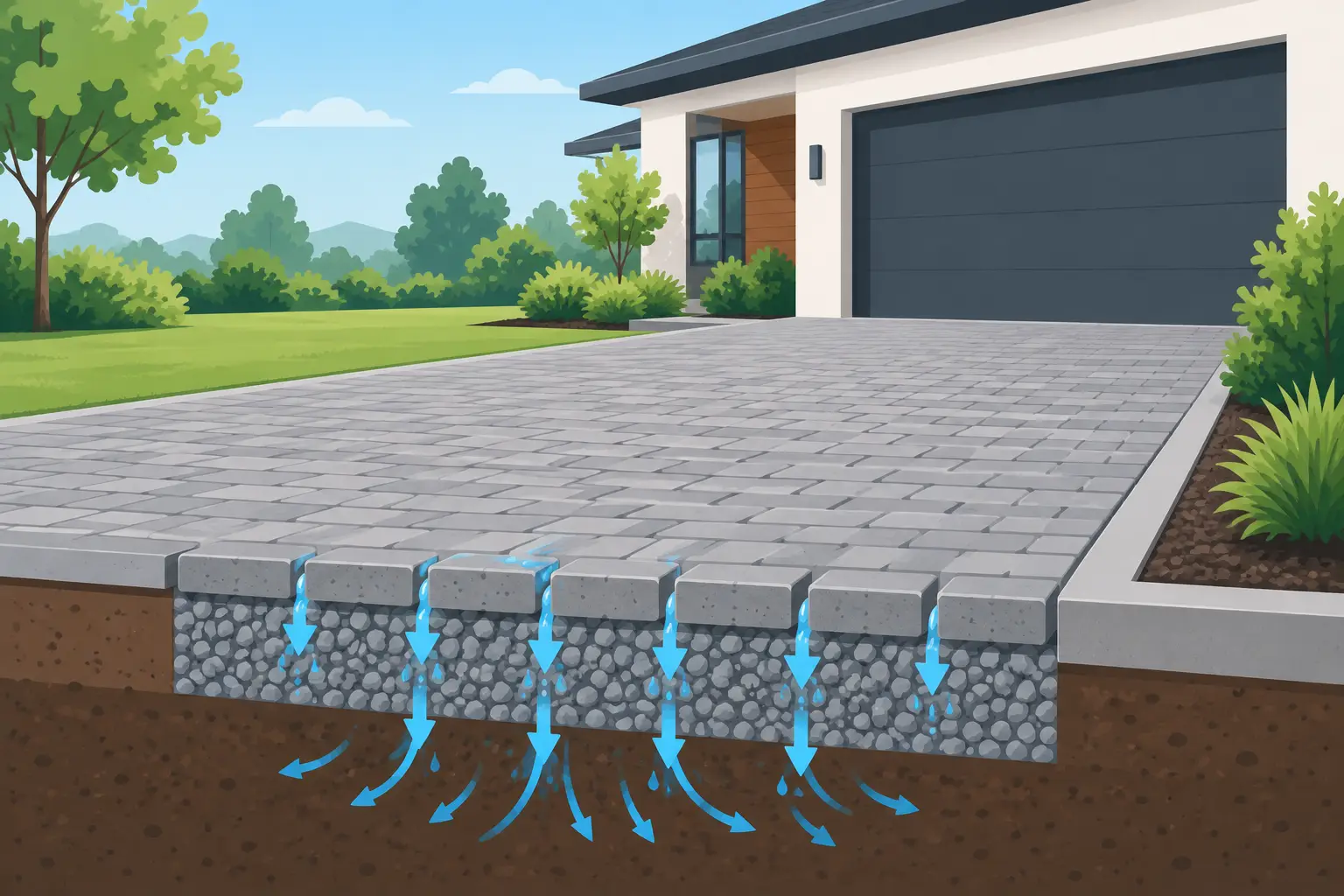
Permeable paving is a paved surface designed to allow rainwater to drain through the joints or surface, into a specially prepared sub-base below. From there, water can soak into the ground gradually or be directed to a suitable drainage point.
It is commonly used for driveways, paths, patios, parking bays and access areas. Rather than sending rainfall straight into gullies and drains, the surface helps manage water where it lands.
A permeable driveway can be made with block paving, porous asphalt, permeable concrete, gravel grids or resin-bound systems, depending on the look required and how the area will be used. For many domestic driveways, permeable block paving is a popular option because it offers a tidy, traditional appearance with good access for future repairs.
Why drainage matters on a driveway
A standard impermeable driveway sheds water across its surface. If the falls are wrong, the water may sit against a wall, run towards a garage or spill onto the pavement. In heavy rain, that flow adds to the demand on public drainage systems.
Permeable paving reduces surface run-off by letting water move down through the paving construction. It can also reduce splashback, help prevent localised puddling and avoid the need for prominent channel drains in some layouts.
That does not mean it is the right answer for every property. Ground conditions, the slope of the site, soil type and the level of the water table all matter. Clay-heavy ground, which is common in parts of the South West, may drain slowly. In these cases, a permeable system may need an appropriate drainage outlet, attenuation layer or other designed solution rather than relying solely on soakage into the soil.
How a permeable paving system is built
The visible surface is only one part of the job. Good groundwork determines whether permeable paving continues to drain well and remains stable under vehicles.
The paving surface
Permeable block paving uses blocks with wider joint spaces than conventional block paving. Those joints are filled with clean, angular aggregate rather than ordinary kiln-dried sand. Rainwater passes through the joints while the aggregate holds the blocks in position.
Other materials can work well, but each has different strengths. Gravel is cost-effective and naturally free-draining, although it can move under tyres and needs occasional raking. Porous asphalt gives a clean, continuous finish but needs correct installation and is less straightforward to patch invisibly. Resin-bound gravel can look smart for paths and lighter-use areas, but quality preparation is essential and not every resin surface is permeable.
The bedding and sub-base
Under permeable blocks sits a layer of clean, open-graded aggregate. This supports the paving while allowing water to pass through. Below that is a deeper sub-base made from larger clean stone. The gaps between the stone store rainwater temporarily before it drains away.
This is very different from a conventional driveway base, which often uses compacted material containing fine particles. Fine material is useful for forming a dense base, but it can restrict water movement and is not suitable for a permeable build-up.
A geotextile membrane may be used to separate the stone layers from the surrounding soil. It helps stop fine earth migrating into the sub-base and reducing its drainage capacity. The depth of excavation and stone required depends on the ground, vehicle loading and drainage design. A footpath does not need the same construction as a driveway used by vans, repeated deliveries or heavier commercial traffic.
Levels and edge restraint
Permeable paving still needs correct levels. Water should enter the surface rather than be directed towards a building. The finished driveway must sit at a safe level below the damp-proof course, with suitable consideration given to door thresholds, garage entrances and existing drainage.
Strong edge restraints are also essential. They keep blocks, gravel or other surface materials from spreading under use. Weak or poorly installed edging is one of the main reasons a driveway begins to look untidy at the sides.
Choosing the right material for the job
The best surface depends on how the area will be used, the style of the property and the budget. There is no single material that suits every driveway.
Permeable block paving is a good all-round option for domestic driveways. It comes in a wide range of colours and laying patterns, individual blocks can be lifted for local repairs, and it suits traditional and modern homes. It does, however, need regular maintenance to keep the joints clear.
Gravel grids are useful where a more natural finish is wanted or where retaining gravel is a concern. The cellular grid provides structure, helping limit rutting and migration. It works particularly well for parking areas, rural properties and lower-cost access routes.
Porous asphalt may suit larger areas where a simpler appearance is preferred. It can be useful for commercial parking, access roads and practical hardstanding, provided the base is designed correctly. It is less decorative than paving blocks, and repairs need care to maintain a consistent finish.
For patios and garden paths, consider the amount of foot traffic, furniture and shade. A surface beneath overhanging trees may collect more leaves, pollen and moss, so the maintenance requirement should influence the choice.
Planning and drainage considerations
Driveway work can be affected by planning and drainage rules, particularly at the front of a property. In many cases, using a permeable surface can help avoid the issue of rainwater being discharged onto the highway or into the public sewer. However, the details matter.
Listed properties, conservation areas, new or altered vehicle access, and work that changes levels substantially may require additional checks. Commercial sites can have further requirements, especially where vehicle use, contaminated run-off or larger drainage volumes are involved.
Before work starts, a competent contractor should assess the fall of the land, nearby walls and buildings, existing drainage, soil conditions and how vehicles will use the area. A good-looking driveway is not enough if water is being sent towards the house.
Installation mistakes that cause problems
Most permeable paving failures start below ground. Skimping on excavation, using the wrong aggregate or laying paving over an unsuitable base can lead to movement, pooling and blocked joints.
Watch out for surfaces installed with too much fine sand, no proper edge restraint or inadequate depth for the vehicles using the space. Another common issue is connecting a permeable surface to a drainage route that cannot cope in heavy rainfall.
Poor falls can also cause problems. Although water drains through permeable paving, the area should not be shaped so that large volumes run from an impermeable roof, path or neighbouring surface onto one small section of the driveway. Rainwater needs to be managed as part of the whole property, not treated as an afterthought.
Maintaining permeable paving
Permeable paving is not maintenance-free, but routine care is straightforward. Sweep away leaves, soil and debris before they build up in the joints. This is particularly important in autumn and in shaded gardens where organic matter collects quickly.
Use a brush or low-pressure cleaning method where appropriate. Aggressive pressure washing can remove jointing aggregate and disturb the surface if it is not done carefully. If joints are depleted after cleaning or normal use, they should be topped up with the correct clean aggregate.
Oil spills should be dealt with promptly, especially on driveways and parking areas. Weeds are usually caused by seeds settling on the surface rather than growing up from below, so regular sweeping and suitable weed treatment will keep the area looking cared for.
A well-built permeable driveway should drain evenly. If water starts pooling in one place, do not ignore it. The cause could be compacted joints, accumulated debris, settlement or an issue with the drainage layer below. Early attention is usually simpler and less costly than allowing the problem to worsen.
Is permeable paving worth it?
For the right property, permeable paving offers a practical way to improve kerb appeal while dealing with rainwater responsibly. It is especially useful when replacing a tired concrete or tarmac driveway that sends water towards the road or the property.
It may cost more initially than the cheapest solid surface because the groundwork and aggregate specification are more exacting. In return, you get a surface designed to manage rainfall, reduce standing water and provide a smart usable area for years to come. The best starting point is a site assessment that looks at the ground beneath your feet, not just the finish you want on top.
Comments